
原卷页面


文字识别版(LaTeX 源)
第1页
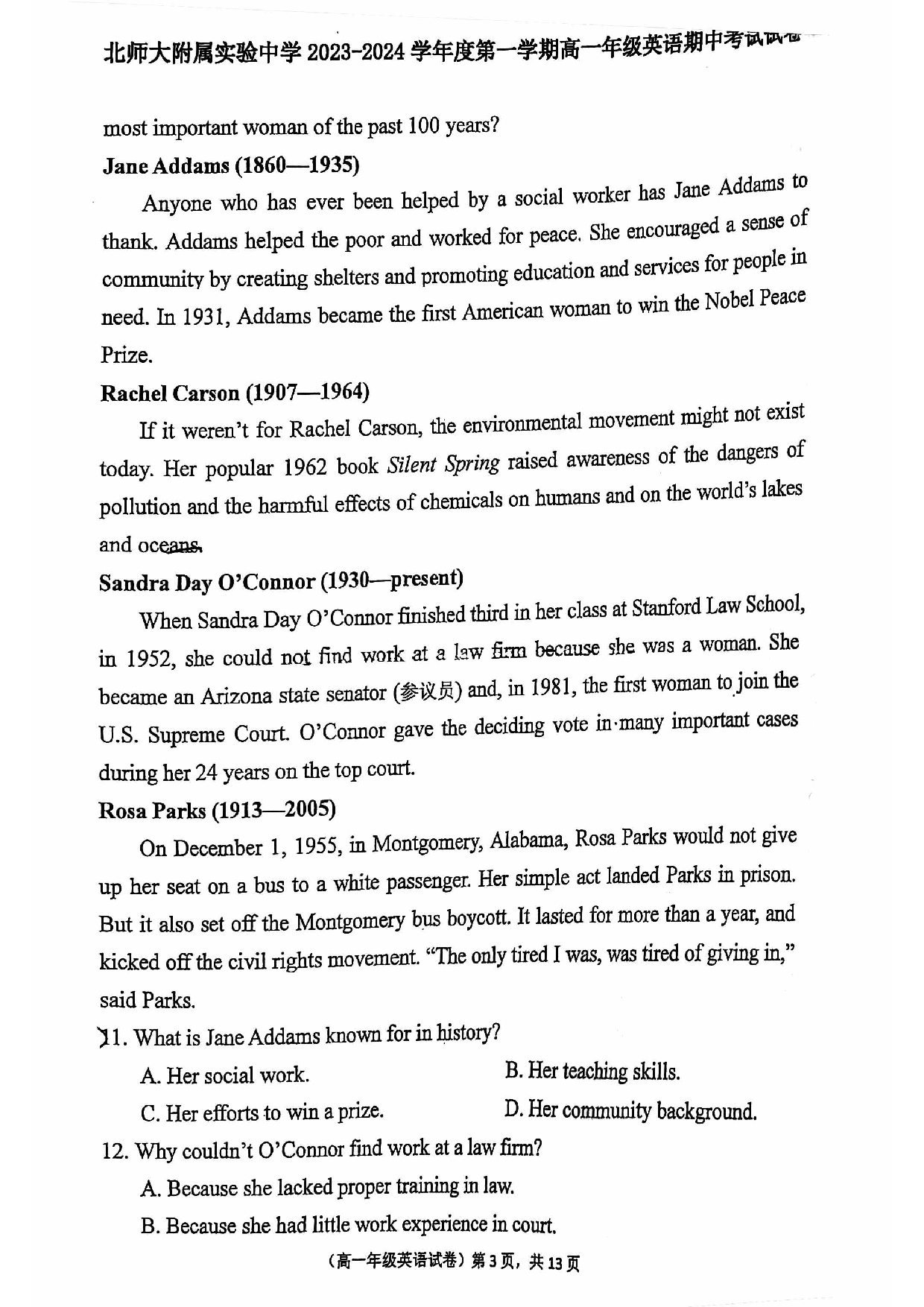
most important woman of the past 100 years? Jane Addams (1860—1935) Anyone who has ever been helped by a social worker has Jane Addams to thank. Addams helped the poor and worked for peace. She encouraged a sense of community by creating shelters and promoting education and services for people in need. In 1931, Addams became the first American woman to win the Nobel Peace Prize. Rachel Carson (1907—1964) If it weren’t for Rachel Carson, the environmental movement might not exist today. Her popular 1962 book Silent Spring raised awareness of the dangers of pollution and the harmful effects of chemicals on humans and on the world’s lakes and oceans. Sandra Day O’Connor (1930—present) When Sandra Day O’Connor finished third in her class at Stanford Law School, in 1952, she could not find work at a law firm because she was a woman. She became an Arizona state senator (参议员) and, in 1981, the first woman to join the U.S. Supreme Court. O’Connor gave the deciding vote in many important cases during her 24 years on the top court. Rosa Parks (1913—2005) On December 1, 1955, in Montgomery, Alabama, Rosa Parks would not give up her seat on a bus to a white passenger. Her simple act landed Parks in prison. But it also set off the Montgomery bus boycott. It lasted for more than a year, and kicked off the civil rights movement. “The only tired I was, was tired of giving in,” said Parks. 11. What is Jane Addams known for in history? A. Her social work. B. Her teaching skills. C. Her efforts to win a prize. D. Her community background. 12. Why couldn’t O’Connor find work at a law firm? A. Because she lacked proper training in law. B. Because she had little work experience in court. (高一年级英语试卷)第3页,共13页
第2页
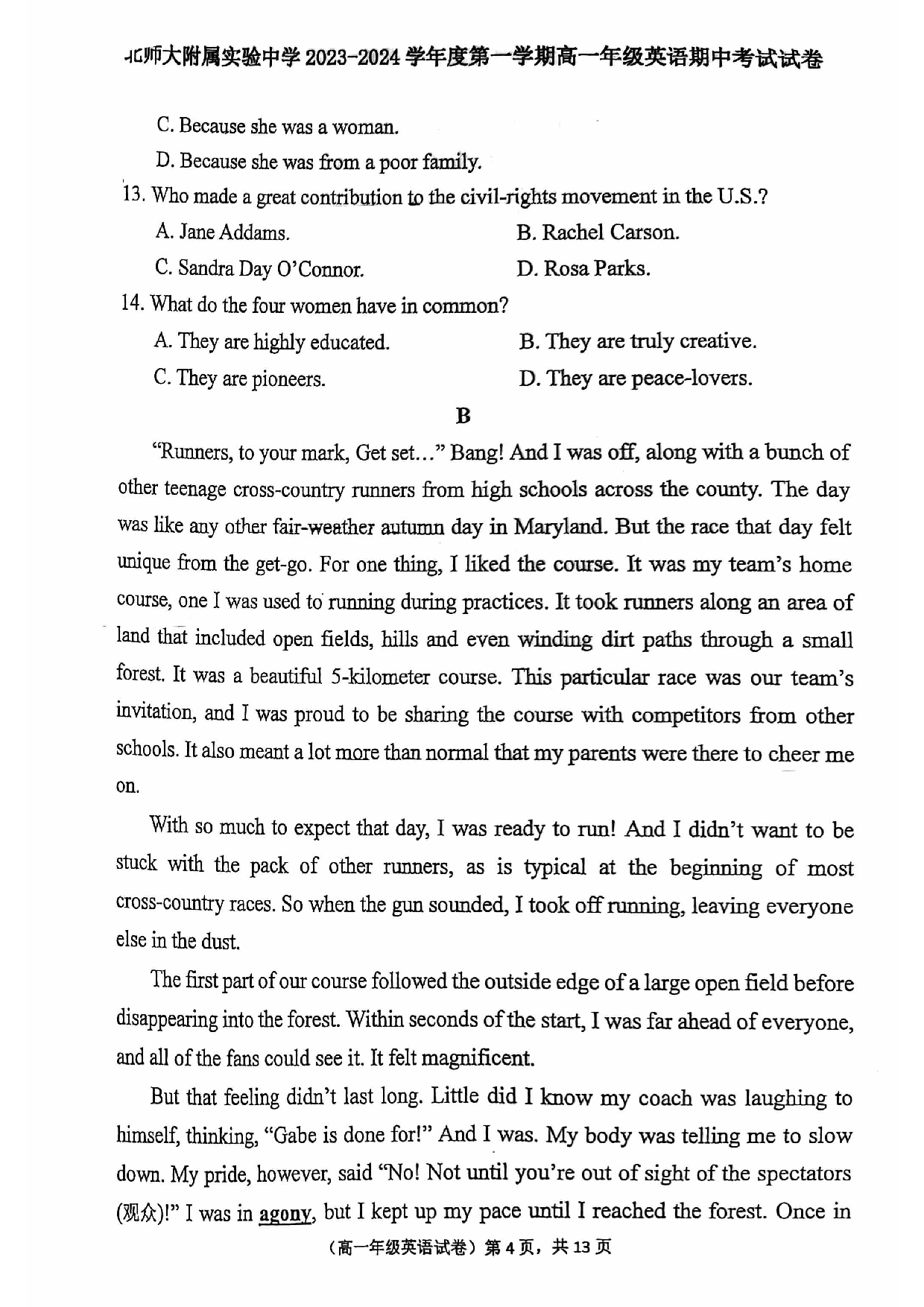
C. Because she was a woman. D. Because she was from a poor family. 13. Who made a great contribution to the civil-rights movement in the U.S.? A. Jane Addams. B. Rachel Carson. C. Sandra Day O’Connor. D. Rosa Parks. 14. What do the four women have in common? A. They are highly educated. B. They are truly creative. C. They are pioneers. D. They are peace-lovers. B “Runners, to your mark, Get set…” Bang! And I was off, along with a bunch of other teenage cross-country runners from high schools across the county. The day was like any other fair-weather autumn day in Maryland. But the race that day felt unique from the get-go. For one thing, I liked the course. It was my team’s home course, one I was used to running during practices. It took runners along an area of land that included open fields, hills and even winding dirt paths through a small forest. It was a beautiful 5-kilometer course. This particular race was our team’s invitation, and I was proud to be sharing the course with competitors from other schools. It also meant a lot more than normal that my parents were there to cheer me on. With so much to expect that day, I was ready to run! And I didn’t want to be stuck with the pack of other runners, as is typical at the beginning of most cross-country races. So when the gun sounded, I took off running, leaving everyone else in the dust. The first part of our course followed the outside edge of a large open field before disappearing into the forest. Within seconds of the start, I was far ahead of everyone, and all of the fans could see it. It felt magnificent. But that feeling didn’t last long. Little did I know my coach was laughing to himself, thinking, “Gabe is done for!” And I was. My body was telling me to slow down. My pride, however, said “No! Not until you’re out of sight of the spectators (观众)!” I was in agony, but I kept up my pace until I reached the forest. Once in (高一年级英语试卷)第4页,共13页
第3页
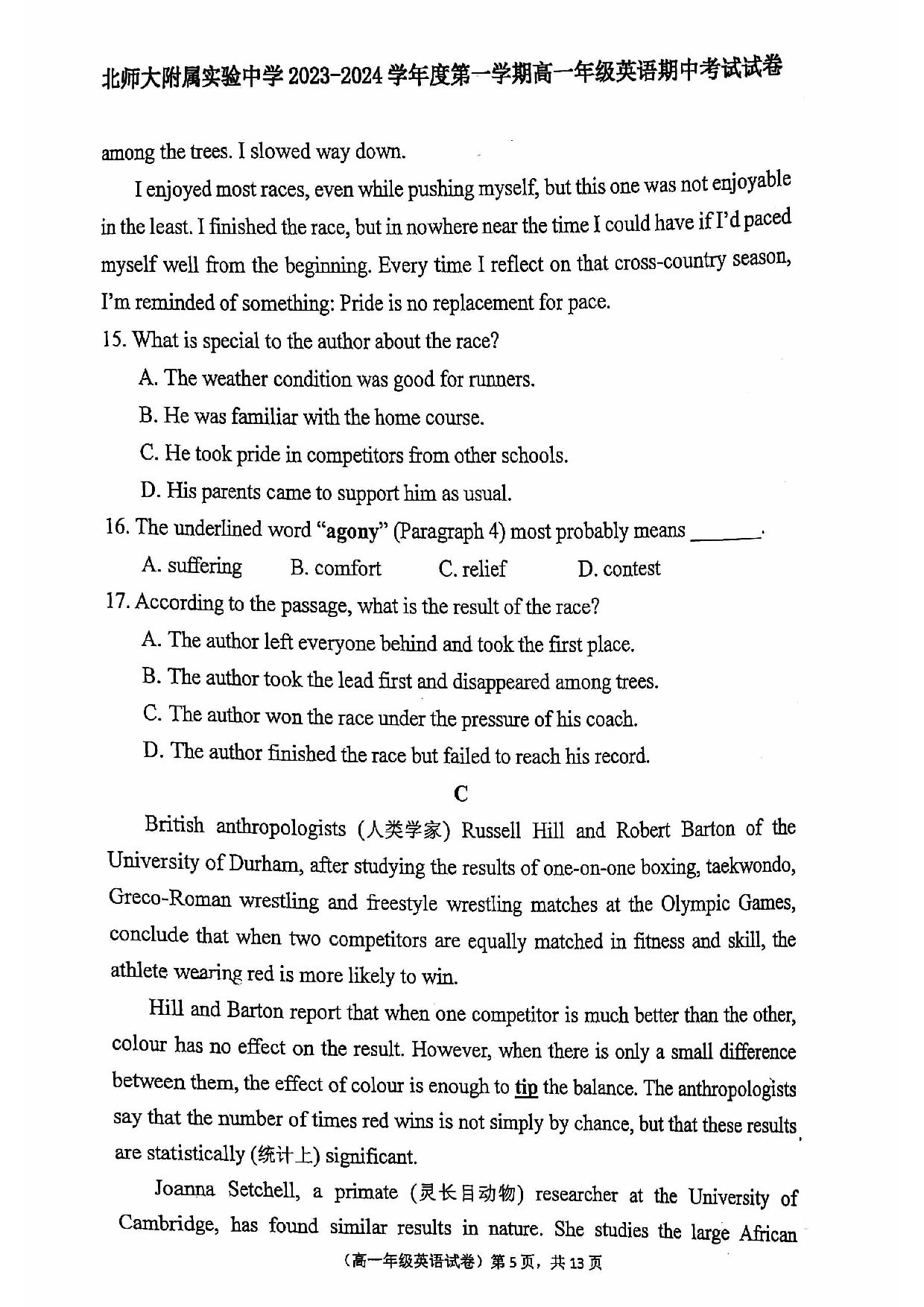
among the trees. I slowed way down. I enjoyed most races, even while pushing myself, but this one was not enjoyable in the least. I finished the race, but in nowhere near the time I could have if I’d paced myself well from the beginning. Every time I reflect on that cross-country season, I’m reminded of something: Pride is no replacement for pace. 15. What is special to the author about the race? A. The weather condition was good for runners. B. He was familiar with the home course. C. He took pride in competitors from other schools. D. His parents came to support him as usual. 16. The underlined word “agony” (Paragraph 4) most probably means ____. A. suffering B. comfort C. relief D. contest 17. According to the passage, what is the result of the race? A. The author left everyone behind and took the first place. B. The author took the lead first and disappeared among trees. C. The author won the race under the pressure of his coach. D. The author finished the race but failed to reach his record. C British anthropologists (人类学家) Russell Hill and Robert Barton of the University of Durham, after studying the results of one-on-one boxing, taekwondo, Greco-Roman wrestling and freestyle wrestling matches at the Olympic Games, conclude that when two competitors are equally matched in fitness and skill, the athlete wearing red is more likely to win. Hill and Barton report that when one competitor is much better than the other, colour has no effect on the result. However, when there is only a small difference between them, the effect of colour is enough to tip the balance. The anthropologists say that the number of times red wins is not simply by chance, but that these results are statistically (统计上) significant. Joanna Setchell, a primate (灵长目动物) researcher at the University of Cambridge, has found similar results in nature. She studies the large African